
-

Our Campus
From Ma Yansong’s architectural vision to Mia Lehrer’s dynamic gardens, the Lucas Museum of Narrative Art emerges from Exposition Park as a place where imagination and everyday life meet.
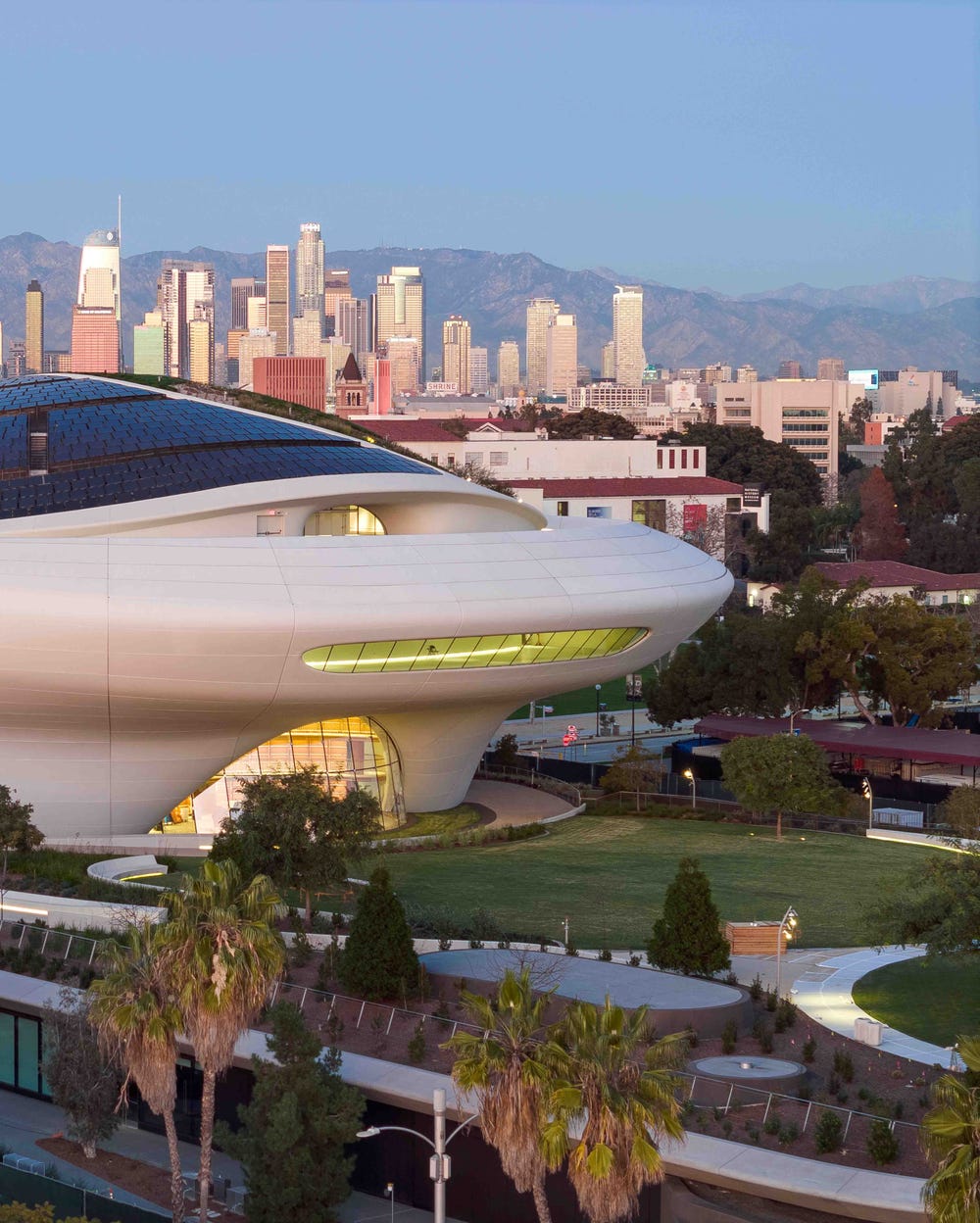
Our home is an 13-acre campus made up of trees and landscaped gardens that surround a 300,000-square-foot (27,800-square-meter) building. Inside, the five-story museum offers 100,000 square feet (9,300 square meters) of galleries, two state-of-the-art cinematic theaters, and spaces for learning, dining, retail, and more. -

The Park and Gardens
“[The Lucas Museum] seems to hover over the undulating gardens, paths, and meadows at its base.”
—John Jurgensen, The Wall Street Journal
Mia Lehrer and her team at Studio-MLA have transformed former parking lots into a living landscape. Native and drought-tolerant plantings, more than 200 new trees, and landforms inspired by the city’s geography create a shifting environment. Paths, meadows, and shaded gathering areas offer much-needed green space for the South Los Angeles region.
The museum also incorporates sustainable design throughout the campus. Its landscaping captures rainwater for irrigation, a waterfall-like fountain contributes to renewable cooling, and solar panels on the roof supply clean energy. -

The Architecture
“This art is important. Let's put it in an important building.”
—George Lucas, co-founder
Architect Ma Yansong, founder of MAD, conceived the museum as a sculptural, organic form shaped by light, clouds, and the surrounding tree canopy. Rising from Exposition Park, it feels both grounded and ethereal, embodying the museum’s belief in imagination as a shared public resource.The building is the culmination of a 15-year collaboration between Ma and the museum’s founders, with Michael Siegel of Stantec as executive architect. “Sometimes I don’t need words to explain,” Ma says of George Lucas. “He can just feel it.”
Lifted above the ground, the museum engages with the street on a human scale, encouraging social interaction while preserving views of Exposition Park. -

The Galleries
Explore worksThe museum’s galleries—more than 100,000 square feet (9,300 square meters)—present works organized around enduring themes, from the everyday to the fantastical.
-

The Library
Learn moreThe museum’s library is both a research center and a quiet space for reflection. It supports scholars, students, and curious visitors eager to explore the breadth of narrative art.
-

Retail, Dining, and Theaters
Skywalker GrillThe Lucas Museum is designed as a place to spend an entire day—and evening—in one dynamic setting. In addition to its galleries, our five-story building features two state-of-the-art cinematic theaters. Visitors can enjoy a café and a rooftop restaurant with sweeping views of the city. Retail spaces offer signature merchandise inspired by works in the museum. Throughout the building, flexible spaces support public programs, learning opportunities, and community engagement. Together, these spaces create an experience that moves seamlessly from curiosity to discovery, conversation, and beyond.
-

Exposition Park
Located in South Los Angeles’s Exposition Park, the museum stands within a constellation of cultural institutions and a wider community rich in history, creativity, and learning.
The park itself dates to 1872, when the state of California set aside the land for agricultural fairs and exhibitions: a public gathering place devoted to education, industry, and exchange. Over the next century and a half, it evolved into a civic and cultural hub and has served as a venue for two Olympic Games, in 1932 and 1984, and will do so again in 2028. Today, the 160-acre (65-hectare) park includes the Natural History Museum of Los Angeles County, the California African American Museum, the California Science Center, the LA Memorial Coliseum, BMO Stadium, and the Exposition Park Rose Garden. The University of Southern California (USC) is just across the street.


